
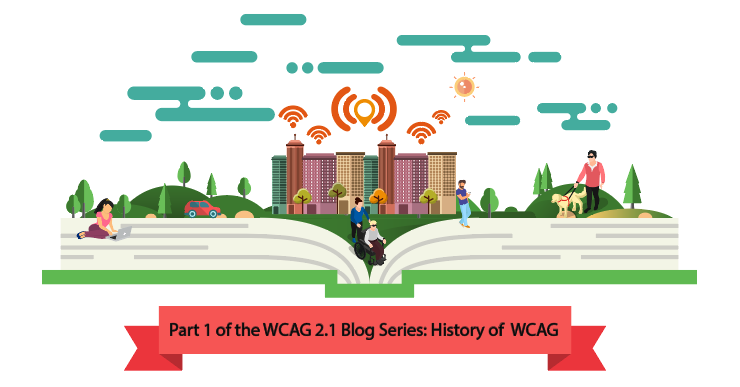
What is WCAG 2.1? Ooo that’s an exciting question. I’d like to address it in parts if you don’t mind. My name is Glenda “The Goodwitch” Sims and I’ve been in the field of accessibility since before 2000. Right now, I have the great privilege of being an active member of the Accessibility Guidelines Working Group at the W3C. That’s what I do as a volunteer position. My day job, is I am the lead of a wonderful group of accessibility experts at Deque.
To answer this question, let’s start by understanding the history of the Web Content Accessibility Guidelines (WCAG). If video is your preference, please feel free to follow along with the recording below, which includes subtitles:
What is all this talk about WCAG 2.1 and, by the way, what in the world is WCAG?
The Web Content Accessibility Guidelines, also known as WCAG (1.0), has been around since May 5th of 1999. Version 1.0 was published on that date many years ago. That first version of the Accessibility Guidelines was very focused on HTML and it was a wonderful step forward in making the web and digital technology accessible. It was followed, a number of years later, December 11, 2008, to be exact, with WCAG 2.0.
What is the difference between 1.0 and 2.0?
WCAG 2.0 had learned a lot in those almost ten years and technology had advanced a lot, as well. In 2.0, the W3C wanted to make sure that the Web Content Accessibility Guidelines was technology agnostic. It wasn’t just focused on HTML because HTML is not the only digital asset that we have and use. Whether it’s PDF or a texted document like Word or a Google Doc or a spreadsheet, or a presentation, or an eBook, or a native mobile app. All of these things are digital assets that need to be accessible.So, WCAG 2.0 in 2008 broadened the technical footprint of what we were covering.
The Four Principles of WCAG 2.0
Another key piece of WCAG 2.0 was the four principles that were established and these principles are great because it’s not just a long checklist of things. It’s a concept of making things digitally accessible for people with disabilities. If you understand the concepts of perceivable, operable, understandable, and robust, you can carry the litmus test too. Is something accessible around with you, in your mind, and in your heart from a high-level perspective? So, perceivable, operable, understandable, and robust were the principles that were clearly delineated in WCAG 2.0. That was a wonderful gift.
Fast Forward from 2008 to 2017: WCAG 2.1 and Silver
So here we are, it’s 2017 and WCAG 2.0 from December 11, 2008, is still our measuring stick for accessibility. The web and digital technology have changed a lot in the ensuing years since 2008. So, there’s been a movement to create a dot release of WCAG, a WCAG 2.1. It’s currently being drafted right now. It’s available for public review.
At a high level, WCAG 2.1 is going to add to 2.0. 2.0 was so well-written in 2008 that it’s stood the test of time in that all of the requirements are still very, very valid. So, hang on to 2.0 and let’s add 2.1 to it. There’s a parallel effort to the WCAG 2.1 dot release. The 2.1 dot release is very focused on filling known gaps. Lastly, there is another movement called Silver, this is Accessibility Guidelines 3.0.
If we could reimagine, with everything that we know today, start from scratch on Mars, perhaps. How would we design Accessibility Guidelines now? That’s the Silver. So, as we look at WCAG, recognize it is a wonderful standard to use today and I’m looking forward to, in future installments, telling you more about the upcoming WCAG 2.1 and Silver in more detail.